
Tags
After lots of looking, many e-mails around the country and a few phone calls, I decided on a prosthetist to try to get me up to speed again. Thank you to the many people who responded to my post about resources for prosthetists. I got lots of good information out of the notes you sent, and even met some good potential people.
I decided upon a prosthetist who just recently opened a practice in Leesburg, Virginia. Obviously, I chose experience over convenience. John has been in prosthetics for about 35 years. The short story is that he built a very successful practice in Seattle. After 20 years he sold it and moved to South Africa (where he was born) to provide limbs to kids that couldn’t afford them. In 3 years time he had provided over 2,100 kids with limbs (you gotta figure he’s got some good karma from that!) When his first grandson was born here in the States, he and his wife decided to return here to be on the same piece of the planet with the newest generation of the family.
Ok, that’s all pretty good, but let’s face it, I’ve been looking for more than qualifications than someone just being a good guy. After a few e-mails and a couple long phone conversations I felt that this guy had the right combination of creativity, experience and interest in working with a challenging patient like me. He presented several ideas for each challenge I talked about, and shared things that worked with other patients. One of the more creative solutions he told me about was for another skydiver with a below knee amputation on one leg, and above knee on the other leg. Since it’s really tough for a guy guy like that to run, landing was a challenge. To accommodate that challenge, John built a leg that incorporated a wheel in the knee joint of the above knee prosthesis. You can’t buy that kind of shit out of a prosthetic catalog!
His new practice is a small scale, one patient at a time practice. Literally, I’m the only patient he’s working with this week. John is doing the work from start to finish himself, and since he owns the practice, there’s no one looking over his shoulder telling him to book more appointments. There are a lot of corporations out there thinking that prosthetics is a cash cow. In many cases they are right… if you don’t have to deal with people that train horses, ski, skydive, and just generally rock at life. They’re all about the patients that just want to get a leg under them that will let them get to the bathroom, the fridge and the couch. That’s fine, somebody has to take care of the uninspired. I’ll go with someone who thinks it’s fun to build stuff that will let me do what I want to do, and doesn’t have to explain why to anyone.
Today’s Appointment
John picked me up a little after 9:30 for the half mile ride to his office. He built the office this spring, and saw the first patient in June, so everything’s tidy and new. Well, actually, I get the impression that it will be tidy a dozen years from now. As far as new goes, well actually a lot of the tools and equipment John either hand built, or had acquired along the way of 35 years of prosthetic practice… and they all still look new.
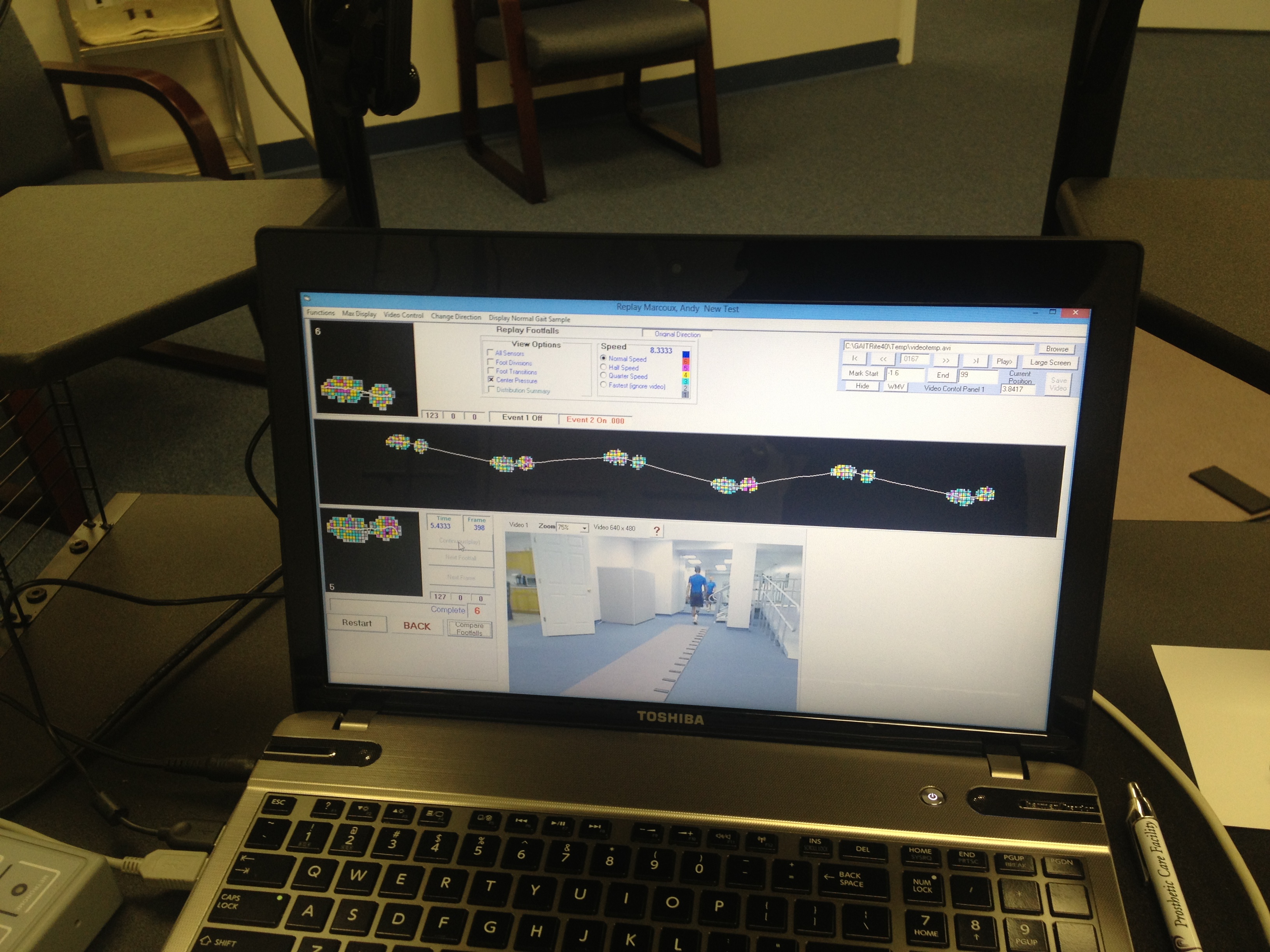
My steps as seen by the computer
After the nickel tour we went to work in the gait room. I did a couple of walks along a long gait analysis mat hooked to a laptop with a webcam. The computer recorded my walk on video and on the mat. The mat provided analytics about my foot falls, stride length, duration, and weight. It was pretty cool. The big standout was weight loading from one side to the other. It showed that I was carrying more weight for longer on my OEM (real) leg. OK, this is not shocking news. My left leg ends the day sore as hell these days. I always take that as a sign that things are not going right with my prosthetic side.
The Start of the New Build
The first step in building a leg is for the prosthetist to make a model of the patient’s leg. It starts by making a cast of the leg, then filling that cast with plaster to make a 3-D model of the leg. Once they have that, they can modify it for shape and size, and use that model to build check sockets upon.
This is where I get my first glimpse into a prosthetist’s skill set. It’s a pretty intimate process. As the practitioner is evaluating my residual limb, his hands are making a mental map of it the whole time. This isn’t the place to be shy or homophobic. It’s hands on. A practitioner’s confidence and competence comes through pretty clearly in this process.
As John mapped my leg through measurements and feel, he pointed out what he was finding as he went. He noted where he could feel the main nerve branch that has been problematic for for me. On the upside the two other branches were relatively undetectable, meaning they are lying low, quiet, and unirritated. Once he he felt like he had all of the information and measurements he needed, he put a liner on my leg, and repeated, noting changes.

The standing cast mounted on the stand
Then we moved on to the casting process. However, with John there is an extra step that I have not had before. He first created a sort of half cast with some room in it, and mounted that cast upon a plastic ring. The ring and cast then mounts on a weight bearing casting stand. Then he creates the normal snug fitting cast over just the leg liner. Finally I slid my casted leg into the cast mounted on the stand, and stood fully weight bearing in the whole set up. The cast on my leg molds to the standing cast. Once I’d been weight bearing for a spell, John finished off the bottom of the cast.
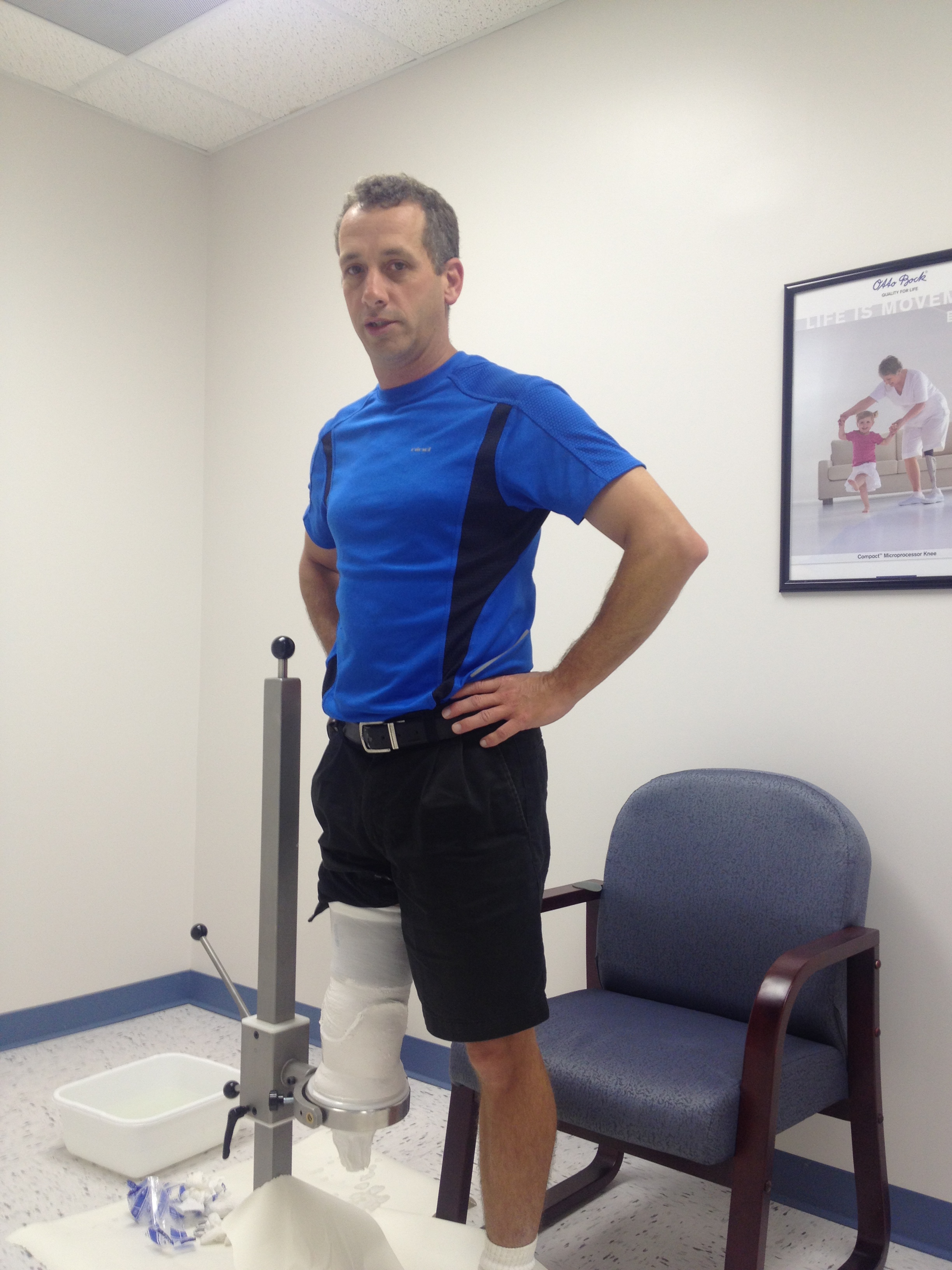
It looks like I’m standing in thin air with the cast stand!
This makes great sense! Usually people are cast sitting on a table or a chair with the leg relaxed. Yet, when we stand and bear weight into a socket, we flex our muscles, tissue is pulled upon and distorted, and even the bone configuration changes (that was a new one on me!) John showed me how the tibia head actually changes position in the leg when we are standing. It’s really easy to do this yourself. Straighten your leg in front of you and find your tibia head (that’s the bone on your leg just below and outside your knee.) Now, make sure you keep your finger on your skin on that spot, then bend your knee 90 degrees. You’ll find that tibia head has moved up and back about a half an inch! Huh, cool stuff!
This is the first time in ten years and half a dozen prosthetists that I’ve seen this technique. John said that in Germany, where he was trained to be a prosthetist, this system is commonplace. However here in the states it’s relatively rare. Tomorrow we’ll try out the first test socket to see how the casting process went. Hopefully I’ll have a leg to put some mileage on the afternoon. Updates to come…
 Amped Skydiving
Sounds exciting and promising! Good luck tomorrow ❤
Wow, I can’t believe that USA medicos are fitting leg prostheses by casting while sitting (but I’m not really surprised). I am neither an amputee nor an athlete, but even I know that leg muscles standing and leg muscles flexed and relaxed are completely different. Sheeit! One needs a weightbearing leg to STAND on, not sit with.
No pressure John.
I am very glad to hear that you went with John! He really is an artist!
Very cool stuff, thanks for the update, glad it’s going well
Nice story. Ask Jan if he has any BILTONG for you?
Thanks for suggestion, believe it or not, he had some! Yum!
Great stuff !!!! (We need an update please…)
All this casting seems old school, couldn’t he just stick your leg in a 3d copier? -jk
But seriously, I think it’s fascinating stuff, and am glad that I happened across your blog when checking your lesson schedule.
I would say “Good Luck”, but you won’t need it! John is the best out there. I have known him for over 20 years. Shortly after I first met him, he started building my hip disarticulation leg(s) in Seattle. Looking forward to seeing him soon in Leesburg. All the best.
My name is MichiI’m a Bilateral Knee Disarticulation Congenital Deformity
So when I was 5 ½ May 26 1964 they amputated my right leg and
April 27 1965 they amputated my left leg. So I have been using prosthesis for
49 years.
So in 1992 my life changed I met the GREAT John Hattingh.
He changed my life forever.
I did not know that I could walk without looking like Frankenstein and
Squeaky Everyone one know when I was coming. I could not sneak up on my kids.
Then I met John and he had me walking like a lady, I could get out of a chair without
having to get on my knees first and pushing up. He gave me some new modern
Knee that help with getting out of chairs…
There is so much more to say about John. But what I really want to say is a
Big Thank You, to you.
And if any of you ever have a chance to go see I John I highly recommend him.le and This is my story on how what John Hattingh has done for me..
Thank you .